
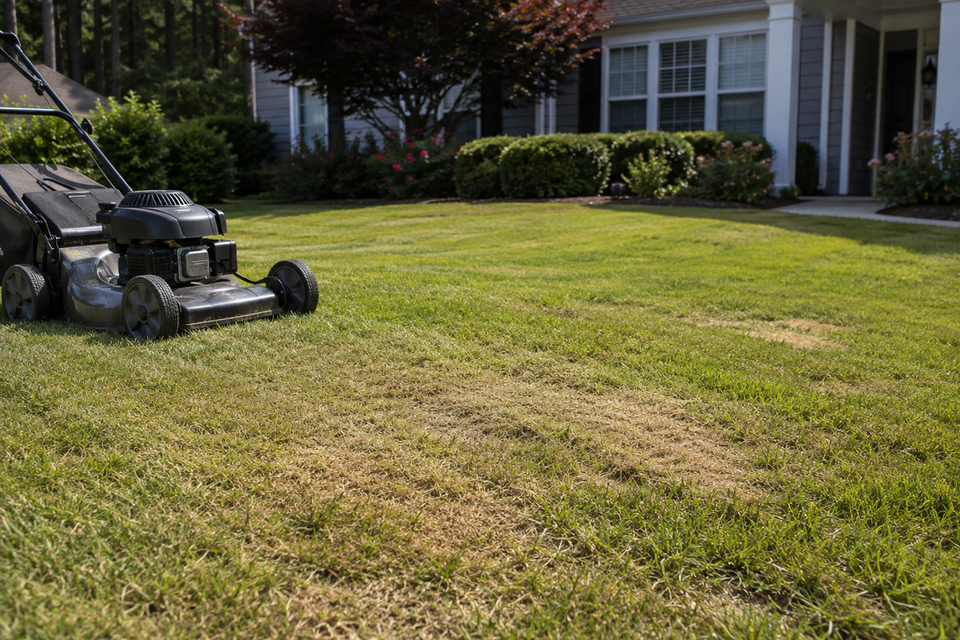
How Short Is Too Short? The Mowing Mistake That Stresses Lawns Fast
A lot of lawns start struggling in late spring for one simple reason: they are being cut too short. Homeowners often think a shorter cut will keep the grass looking cleaner longer, but cutting too low can stress the lawn fast. In Georgia, UGA guidance says mowing height depends on the grass type, and mowing should remove no more than one-third of the total blade height at one time. UGA also warns that lower mowing heights reduce turfgrass photosynthetic capacity, while scalping can thin the turf and make weed problems easier to establish.
Why Cutting Too Short Causes Trouble
Grass needs enough leaf surface to keep growing strongly. When too much of the blade is removed at once, the lawn has to spend energy recovering instead of thickening up and staying healthy.
That usually shows up as:
- a pale or stressed look after mowing
- thin spots that were not there before
- scalped areas on uneven ground
- more weeds showing up in weak turf
- slower recovery between cuts
- a lawn that dries out faster in warm weather
UGA’s lawn guidance notes that removing more than one-third of the blade stresses the grass, and it recommends slightly higher mowing in hot weather for Georgia lawns.
The Real Problem Is Not Just Height, But Timing
Sometimes the issue is not that the mower is set too low every single time. Sometimes the issue is waiting too long, then cutting too much off at once. Even a reasonable mowing height can stress the lawn if the grass has gotten too tall and too much is removed in one pass.
That is where homeowners often create problems without meaning to. They get busy, the yard jumps up, and then the mower takes off far more than the lawn can comfortably handle. The result is a yard that can look rough almost overnight.
Recommended Mowing Heights Depend on the Grass
Different lawns should not all be cut the same. UGA guidance lists these general home-lawn mowing heights in Georgia:
- Common bermudagrass: 1 to 2 inches
- Hybrid bermudagrass: 1 to 1.5 inches
- Centipedegrass: 1 to 2 inches
- St. Augustinegrass: 2 to 3 inches
- Zoysiagrass: generally 1 to 2 inches, though some finer types may be maintained lower